
The new KPIs of connection
Why emotional resonance needs its own measurement system in the age of AI
2025 was undoubtedly the year of AI in marketing. The tools were popping up left, right and center. Their powers extraordinary: they predict intent, generate ideas in seconds, and optimize at a speed no human team could ever keep up with.
As the year went on, however, it became painfully clear that efficient content is not the same as meaningful content. We found out that while you can automate reach, you can’t automate resonance.
Emotionally engaging ads often drive significantly higher results: one Nielsen consumer neuroscience analysis of FMCG ads found that emotionally engaging ads with above‑average scores were linked to roughly a 23% increase in sales.
Research summarised in Harvard Business Review indicates that emotionally engaged customers can be around 50% more valuable than highly satisfied ones.
The question then becomes: how do we measure emotional resonance?
For years, we’ve measured clicks, opens, views, cost per lead. These numbers tell us what people did, but not what they felt. Nielsen points out that traditional survey metrics such as recall and intent are weak stand‑ins for the emotional connection an ad builds.
We need a new set of metrics: a system that recognises not only how our audience behaves, but the emotion behind it. Metrics that show us if our messages are landing the way they were intended to.
Here’s what that new measurement ecosystem looks like:
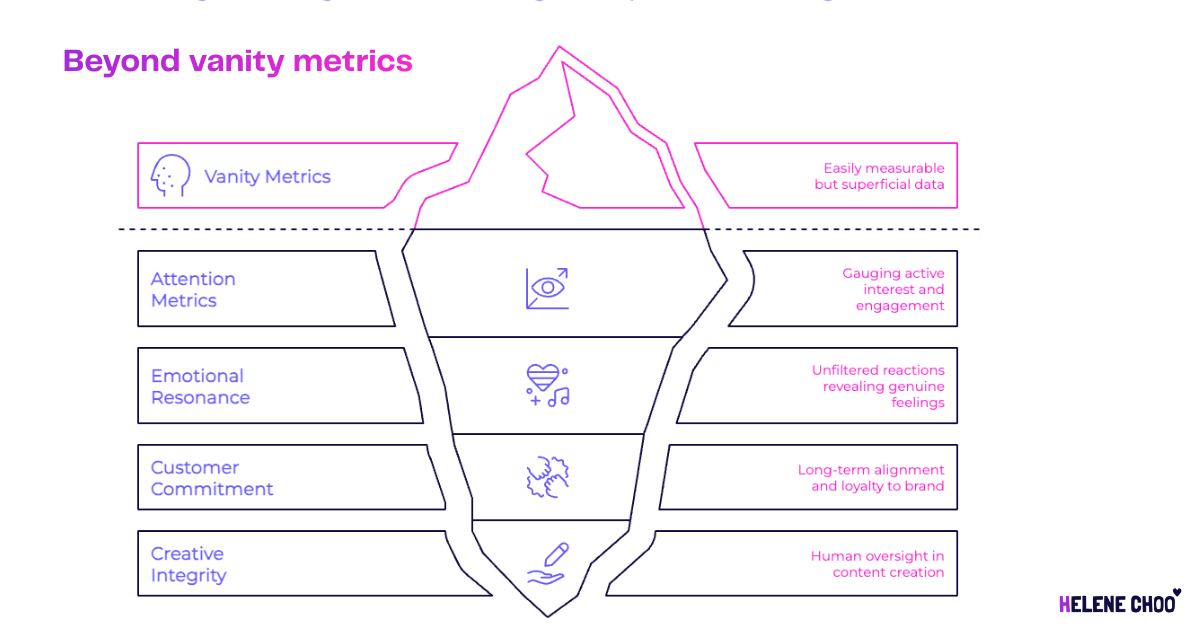
attention as a signal of care
Attention cannot captured by a view or a click. We need to find out: did someone actually sit with the message? Did they scroll to the bottom of the page, watch a video to the end, or come back to it again?
The industry is shifting toward “attention metrics”. Advertisers increasingly want to know if an ad was noticed and held interest, not just if it was served.
Time-on-page, scroll depth, video completion rates…these indicate active interest.
A high click-through rate might get you excited, but if those clicks result in 2- second bounces, it’s telling you nothing about resonance.
By contrast, if someone spends three minutes reading a story (when the average is one minute), that’s a sign of care.
There’s evidence that focusing on attention metrics pays off: Nielsen research shows ads that scored above-average on attention and emotional metrics in testing drove significantly higher sales, proving that when we truly capture attention, we often capture hearts and wallets as well.
So start treating attention as a quality metric. Those extra seconds of engagement could mean your message mattered to someone, and that’s worth far more than a thousand fleeting impressions.
Emotional responses in open channels
If you want to know how your marketing made people feel, look at what they do in the channels where they don’t have to be polite. Comments, replies, DMs, forums like Reddit: these raw, unfiltered reactions are often more insightful than formal feedback surveys.
Are people thanking you? Challenging you? Sharing their personal stories or confessing how your message moved them? Emotional resonance shows up in the language people choose when they aren’t performing or ticking boxes on a questionnaire.
AI tools can be used to analyze these open-channel responses at scale. They can sift through a huge amount of comments and messages to identify tone, sentiment, and intensity. AI can pick up on emotional markers like excitement, frustration, curiosity, confusion, across a volume of feedback no human team could read through.
But while AI can surface the patterns, the interpretation still belongs to humans:
Why are people grateful in comments?
Why are they upset or surprised?
The qualitative context matters as much as the sentiment.
Use open channels as your qualitative heartbeat metrics. Maybe your campaign only got modest likes, but the handful of comments include people saying “This moved me to tears” or “I’ve never seen a brand speak about this so honestly.” This signals you struck an emotional chord that isn’t captured in the vanity metrics.
Conversely, a spike in negative replies (“This ad feels tone-deaf” or “I expected better from this brand”) is an early warning system that you missed the mark emotionally.
💬 One 2025 social media benchmark report found that average comments per TikTok post rose by about 73% year over year, indicating that users are increasingly inclined to talk back, not just watch.
So listen to those voices. Track not just how many people saw your content, but what words they responded with.
Commitment vs. Conversion
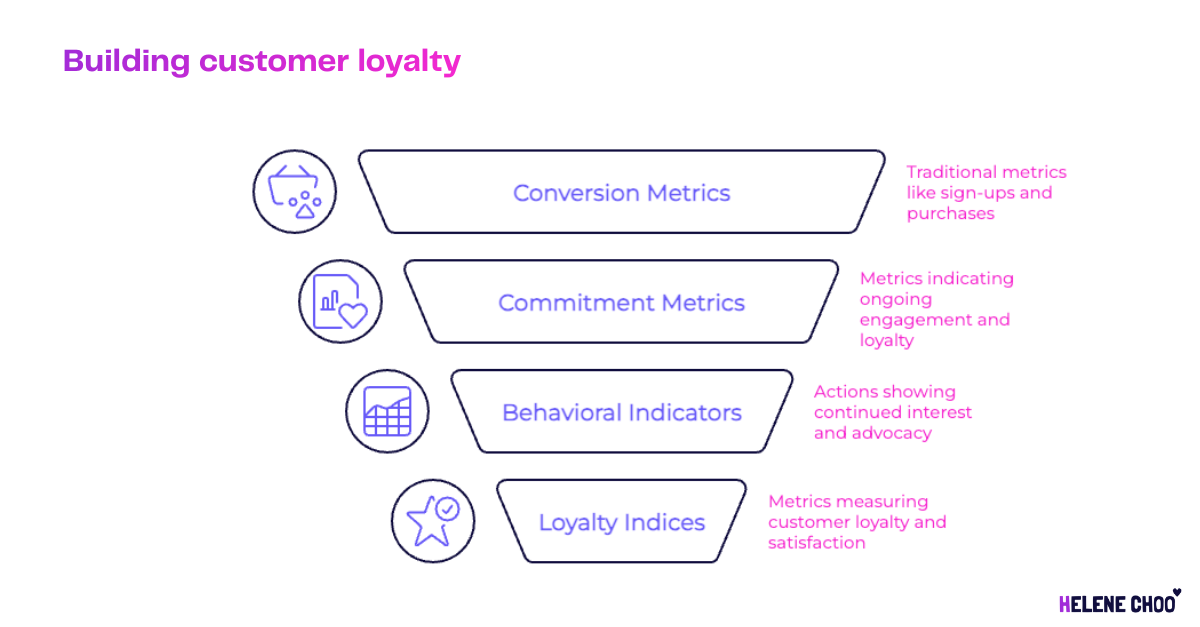
Traditional conversion metrics like sign-ups, purchases, or form-fills, are important, but they don’t tell you how someone feels after that point, or whether they’ll ever come back.
Now that trust has become the biggest driver of value, we should start focusing on commitment metrics. Are people sticking around and aligning with your brand beyond a one-time transaction? Do they come back without heavy retargeting or bribery discounts? Will they recommend your brand to friends without being incentivised to do so? These are the signs of commitment, the closest thing we have to evidence of genuine emotional loyalty.
Why prioritise this? Because a customer who feels aligned with your brand is immensely more valuable than one who clicked “Buy” once and disappeared.
💰 Research by Bain & Company found that increasing customer retention by just 5% can boost profits anywhere from 25% to 95%. That staggering leap is because committed customers buy more over time and they often cost less (you’re not re-acquiring them).
💝 One study showed that 71% of customers will recommend a brand they feel an emotional connection with – an endorsement no ad budget can buy.
Look at behavioural indicators of ongoing engagement: repeat purchase rate, churn rate (or its happy opposite, retention rate), product usage frequency for subscription services, and organic advocacy (mentions and referrals that weren’t part of a referral program).
For content and community, it could be returning website visitors, long-term email open rates, or the ratio of active community members to lurkers. Even something as simple as how many users save or bookmark your content can signal that they found it valuable enough to reference later.
Importantly, these metrics emphasise quality of connection over quantity. Ten thousand new leads mean little if none turn into loyal customers. On the other hand, a smaller number of deeply committed customers can drive disproportionate revenue and growth. This is why companies are expanding their KPI dashboards to include loyalty indices (like Net Promoter Score, repeat purchase frequency, subscriber longevity) alongside the usual conversion numbers.
creative integrity inside the workflow
In a world increasingly flooded with AI-generated slop, marketers need to keep an eye on how the content is made and whether the team is using AI responsibly – as an amplifier, not a replacement.
How often does your team pause to ask, “Is this actually saying something real?” How many times do they rewrite a sentence because it didn’t feel authentic or on-brand? Are you documenting when AI was used only for speed and efficiency, and when a human stepped in to add nuance, empathy, or context that the AI couldn’t grasp?
There’s growing evidence that content produced with human oversight and care performs better than unedited AI output. Vendor reports from tools like Acrolinx indicate that AI‑assisted content performs best when humans oversee quality and brand voice, reducing inconsistency and improving outcomes, but the specific percentage improvements vary by study and are not always publicly disclosed.
📣 It turns out that when you don’t monitor creative integrity, you risk eroding your brand’s voice and connection. We’ve all seen what happens when automation runs unchecked… robotic-sounding blog posts, off-brand social media replies.
You need to build some KPIs around your content creation workflow.
For example:
Track the ratio of content fully automated vs. content that had a human editor or co-creator.
Track the number of “red flag” edits where the team caught an AI output that felt off-tone or insensitive.
Note how frequently your team conducts tone-of-voice reviews or emotional gut-checks on campaigns.
This ensures that how you produce content remains aligned with why you produce it: to connect with humans.
the metrics that will define the next decade
AI will keep accelerating the mechanics of marketing, i.e. targeting, testing, optimizing, and scaling. That part is inevitable and largely positive. What we need to guard against is the erosion of our humanity in marketing.
The brands that thrive will be those that remember the purpose of marketing has never been distribution for its own sake. It has always been connection.
To make that shift, we as marketers must evolve our KPIs. We don’t need to throw out the old metrics entirely. By all means, keep counting clicks and conversions, but put them in context with attention and emotional engagement measures. Keep tracking reach, but correlate it with resonance.
We need to get comfortable with metrics that are a bit “messier” – a bit more qualitative or requiring interpretation – because they get us closer to the truth of impact.
Did our message actually move people?
Did it make someone feel understood, inspired, seen, comforted?
These are tough questions, but now we have frameworks and tools to approach answering them. From neuroscience labs that can tie ad stimuli to emotional brain responses, to social listening AI that can gauge sentiment across millions of posts, to long-term studies linking emotional brand scores to revenue, we have no excuse to ignore the emotional dimension.
We need to start embracing marketing as a relationship-building discipline. And just like any relationship, the things that matter most are often the hardest to quantify – trust, affection, loyalty. But “hard to quantify” is not the same as impossible.
We’re entering an era where marketing leaders will be just as fluent in discussing attention quality, sentiment trends, and community engagement as they are in talking about lead volume or ROAS. They’ll demand to see metrics for heart share alongside market share. 💞
AI can take care of the counting. Humans must take care of the meaning. It’s how we ensure that in a world of infinite content and AI-generated noise, what we create still resonates on a human level. If we redefine our KPIs of success to include emotional resonance, we signal that connection is our end goal.

Marketing Leader on a mission to bring heart and humanity back into marketing
